Unbelievable by John Shelby Spong
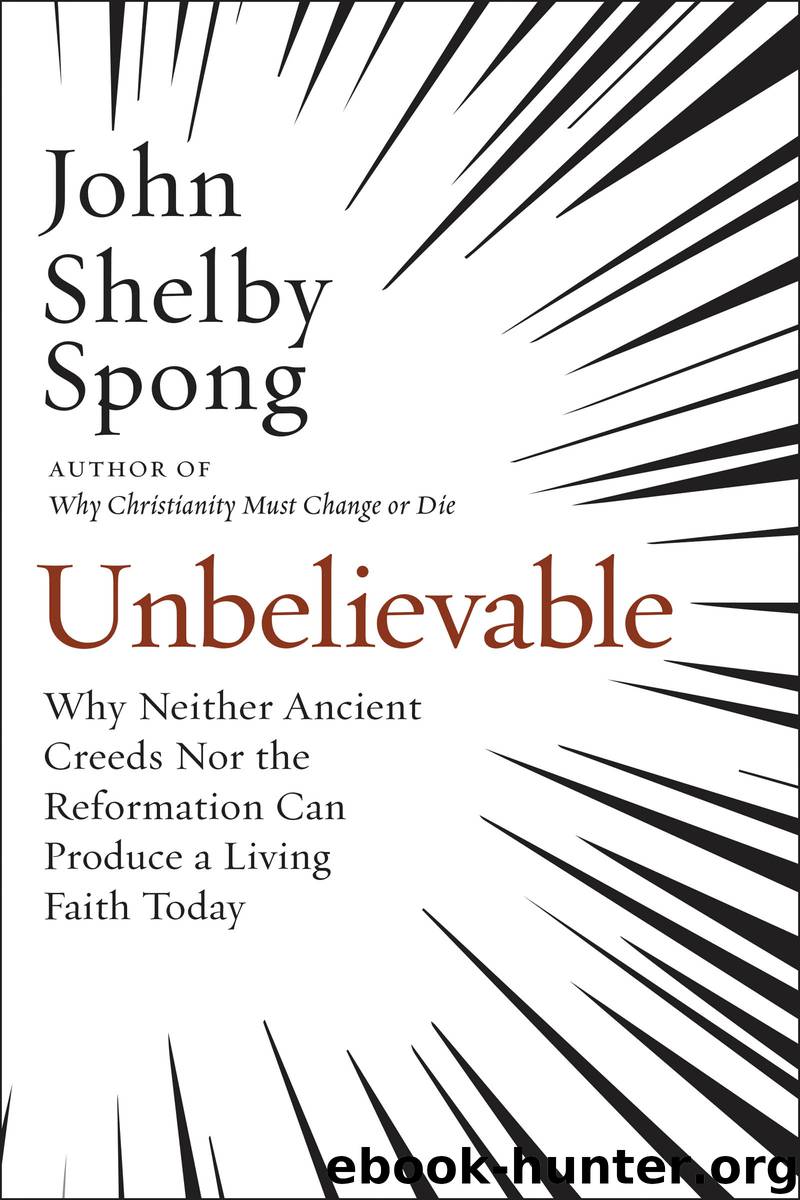
Author:John Shelby Spong
Language: eng
Format: epub
Publisher: HarperCollins
Published: 2017-12-20T05:00:00+00:00
Part IX
Thesis 7: Easter
The Easter event gave birth to the Christian movement and continues to transform it, but that does not mean that Easter was the physical resuscitation of Jesus’ deceased body back into human history. The earliest biblical records state that “God raised him.” Into what? we must ask. The reality of the experience of resurrection must be separated from its later mythological explanations.
22
The Resurrection
Without Easter, there would be no Christianity! Whatever it was that constituted the Easter experience, the obvious fact is that there was enormous power in that moment that cries out for explanation. That power changed lives; it redefined the way people thought about God; it created a new consciousness; and in time it even caused a new holy day to be born. Each of these changes points beyond itself to something that must be big enough to account for these possibilities. At the same time, this undeniable explosion of power does not lend itself to a particular explanation, and thus it forces us to acknowledge that whatever Easter was and is, we can approach it only inside the time and space vocabulary of human existence, for none of us can escape the limits of our humanity. So over the years, the church has offered a variety of these time- and space-bound explanations. They are contained in what we call the gospels. In time, however, we discovered that these biblical explanations—these narratives of the Jesus story—were filled with contradictions. As these explanations were literalized over the intervening centuries, they served to make believing in the resurrection increasingly difficult, even unthinkable.
Nicholas Kristof, a writer for the New York Times, is a representative of the perspective that treats the resurrection with something other than literalism. He describes himself as one “whose faith is in the Sermon on the Mount, who aspires to follow Jesus’ teachings, but is skeptical that he was born of a virgin, walked on water, multiplied loaves and fishes or had a physical resurrection.”
Kristof interviewed former President Jimmy Carter, who, as an evangelical Christian, is thought to believe in all of these things. He probed Jimmy Carter on the resurrection. Mr. Carter replied: “My belief in the resurrection of Jesus comes from my Christian faith, and not from any need for scientific proof. . . . I look on the contradictions among the gospel writers as a sign of authenticity, based on their different life experiences.”*
Suppose Mr. Carter had had the advantage of the study of the Bible in the way it is done in contemporary theological settings, and had learned the things which we have learned in that environment. Would he still consider the gospels, read literally, to be believable, or would he say that they are unbelievable?
In today’s world, the scholarly and critical explorations of the biblical narratives inevitably bring two facts quickly into our awareness. First, while not one word of the New Testament was written without a firm commitment to the reality of the Easter experience, none of the Bible’s sources represents eyewitness, first-generation reporting.
Download
This site does not store any files on its server. We only index and link to content provided by other sites. Please contact the content providers to delete copyright contents if any and email us, we'll remove relevant links or contents immediately.
The Five People You Meet in Heaven by Mitch Albom(3550)
The Secret Power of Speaking God's Word by Joyce Meyer(3165)
Real Sex by Lauren F. Winner(3006)
Name Book, The: Over 10,000 Names--Their Meanings, Origins, and Spiritual Significance by Astoria Dorothy(2974)
The Holy Spirit by Billy Graham(2941)
0041152001443424520 .pdf by Unknown(2842)
How The Mind Works by Steven Pinker(2811)
ESV Study Bible by Crossway(2773)
Ancient Worlds by Michael Scott(2680)
Churchill by Paul Johnson(2576)
The Meaning of the Library by unknow(2563)
The ESV Study Bible by Crossway Bibles(2546)
The Gnostic Gospels by Pagels Elaine(2522)
MOSES THE EGYPTIAN by Jan Assmann(2411)
Jesus by Paul Johnson(2351)
City of Stairs by Robert Jackson Bennett(2339)
The Complete Dead Sea Scrolls in English (7th Edition) (Penguin Classics) by Geza Vermes(2269)
The Nativity by Geza Vermes(2226)
Ancient Near Eastern Thought and the Old Testament by John H. Walton(2220)
